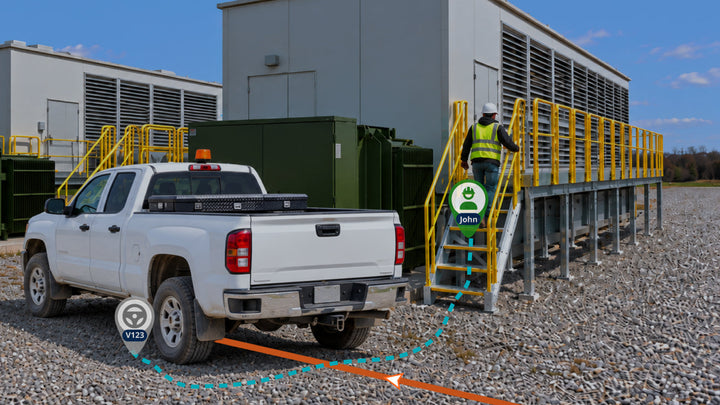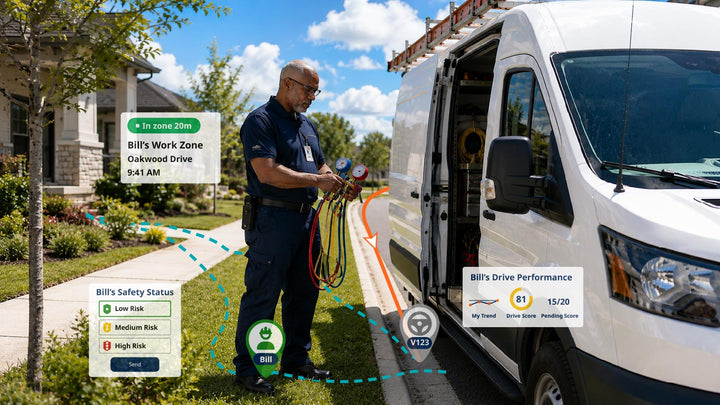


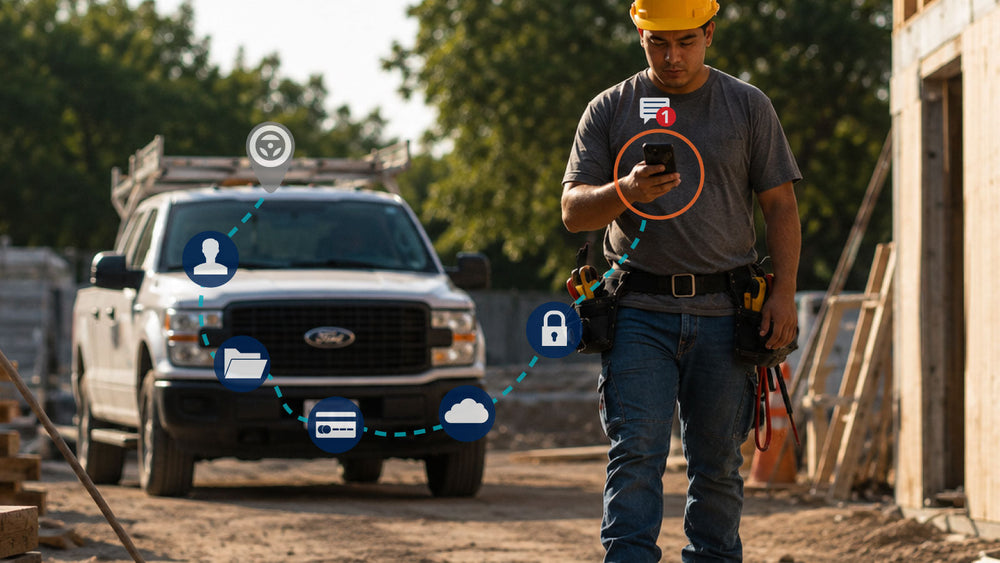
The BYOD security risks that matter for a field service operation are not the ones most policies are written against. The usual threat model is that someone loses a phone and a stranger gets into the dispatch app. The real model is that a single unmanaged phone now carries the customer database, payment card flows, multi-factor tokens for every corporate system, compliance records, and years of business correspondence, all at once. IBM's Cost of a Data Breach Report puts the average breach at $4.88 million globally, with 46 percent involving personal data, and 40 percent of organizations report a breach traced directly to a personal device under a BYOD policy. Meanwhile 1 in 36 mobile devices in a corporate environment carries at least one high-risk app, and 67 percent of organizations say personal device use has negatively affected their security posture.
What does a personal phone actually expose?
The single-app threat model is fifteen years out of date. A modern field technician runs eight to twelve categories of business software on one device, and each one carries its own data classification, vendor security requirement, and discovery exposure.
On that one phone sits the field service management app with customer records, pricing, work history, photos, signatures and payment card data. The CRM with the full customer database and deal economics. Communications tools holding years of internal correspondence. Identity apps carrying credentials and MFA tokens for every corporate system. File repositories with pricing sheets and contracts. Payroll and HR apps with employee identifiers and direct deposit details. Industry compliance apps holding chemical application logs, refrigerant tracking or inspection records that regulators can demand. Mapping apps with timestamped location history that is discoverable in commercial vehicle litigation.
The correct threat model is that a single compromised phone exposes all of it simultaneously. A stolen, unwiped personal phone typically contains corporate email going back years, an active CRM session, banking credentials, and a record of every customer that technician has ever visited.
The exposure also compounds non-linearly across compliance frameworks. A phone holding both payment card data and protected health information triggers reporting obligations under PCI and HIPAA at once. Add EU resident data and GDPR's 72-hour notification clock starts. Add California resident data and CCPA runs a separate clock. One lost personal phone can cascade into several simultaneous incidents.
Which compliance frameworks now require managed devices?
This is the part that has moved fastest, and it is no longer a matter of the operator's own risk tolerance. The vendors of the software your technicians use increasingly require managed devices, and the major frameworks have followed:
-
PCI DSS 4.0 requires that personal devices accessing cardholder data systems meet the same security controls as corporate devices, including approved configuration baselines, authentication and audit logging. Any service company taking a card in the field is in PCI scope, and that control-parity requirement makes BYOD prohibitively expensive to implement correctly.
-
HIPAA Security Rule requires encryption, multi-factor authentication, audit logs and the ability to revoke access on personal devices touching protected health information. Home health, medical equipment service and hospital facilities maintenance are all in scope. The enforcement remedy on a personal device is operationally fragile; on a corporate device it is one action in the management console.
-
SOC 2 requires network segmentation, data isolation, conditional access based on device posture, periodic compliance checks and signed policy acknowledgments for BYOD. Operators serving B2B customers who require a SOC 2 report inherit these obligations.
-
ISO 27001:2022 requires documented mobile device controls, asset registers and tested data-loss prevention. A BYOD environment cannot satisfy the asset register requirement cleanly when the company does not own the asset.
-
GDPR and state privacy laws require breach notification, data subject access and right-to-deletion workflows that all depend on knowing where the data actually lives. On a personal device, the company often does not know.
The cumulative effect is that a managed device has stopped being a productivity preference and become a compliance requirement for most frameworks a field service operator touches.
Do we have to reimburse employees for personal devices?
In at least eleven US jurisdictions, yes, and the obligation is broader than most operators assume.
The defining case is Cochran v. Schwan's Home Service (2014), in which the California Court of Appeal held that Labor Code 2802 requires employers to reimburse a "reasonable percentage" of an employee's personal cell phone bill when the phone is required for work. The court was explicit on two points that reshaped BYOD economics: plan structure is irrelevant (an employee on an unlimited plan who would have had that plan anyway is still owed reimbursement), and whoever paid the bill is irrelevant. The California Supreme Court declined review, so the holding stands. Schwan's is itself a field service operator, which makes the case directly applicable.
Illinois, Massachusetts, New York, Iowa, Minnesota, Montana, New Hampshire, Pennsylvania, the Dakotas and the District of Columbia have statutory or case-law reimbursement requirements of their own.
The tax treatment points the same way. Under IRS Notice 2011-72, an employer-provided phone furnished for noncompensatory business reasons is excluded from the employee's gross income entirely, with no recordkeeping of business-versus-personal use required. A flat stipend not tied to substantiated business use is generally treated as taxable wages, with payroll taxes owed on the full amount. Many operators discover this during an audit.
Isn't mobile application management enough?
Mobile Application Management and containerization isolate corporate apps inside a managed container on a personal device. It is genuinely useful and TRUCE is fully compatible with it. But it has limits worth understanding before relying on it:
-
It does not cover apps the company did not deploy. A technician who photographs a customer's password reset code into a personal notes app has just moved corporate data outside any container you control.
-
It does not control OS-level vulnerabilities. A personal phone on an outdated OS exposes every app on the device, container or not. Corporate devices get pushed updates. Personal devices update when the employee feels like it.
-
It does not control network attachment. A personal phone connects to home WiFi, coffee shop WiFi and a teenager's hotspot. A managed device can enforce VPN-on-by-default or block untrusted networks entirely.
-
It has known iOS limitations. Apple does not allow developers to fully abstract apps from iOS, so containerization there depends on Apple Business Manager and per-app configuration rather than full sandboxing.
MAM has its place, particularly for transitional deployments and office workers using two or three corporate apps. For a field technician running ten or more with PCI, HIPAA or trade-secret data classifications, full management on a corporate device is the cleaner architecture.
What happens when a technician leaves?
Every field service operator has lost a technician on bad terms.
When that technician walks out with a corporate phone, the device is wiped from the management console before the parking lot conversation finishes. Customer records, leads, pricing files and compliance history are gone within minutes.
When they walk out with a personal phone, the company depends on their cooperation. Customer files, photos and contact information may remain on that device indefinitely. In jurisdictions with strong employee privacy protections, which is most of them, recourse is limited to a cease and desist and a hope the data is not used. For pest control operators subject to state chemical-application recordkeeping, or HVAC operators subject to refrigerant tracking, that is a live compliance exposure, not a theoretical one.
Where duty of care comes in
Security and compliance are the obvious cases. The one operators tend to miss is duty of care, and it is where BYOD constrains you most.
A BYOD model limits an organization's ability to enforce the controls that protect people rather than data:
-
Driving-mode application suppression
-
Real-time incident escalation
-
Jobsite communication governance
These are not data controls. They are the mechanisms by which an employer discharges its obligation to keep a mobile workforce safe, and each one requires policy enforcement on the device itself. On a personal phone every one of them is available only by consent, and that consent has to be re-obtained whenever the policy or the device changes. On a corporate device they are simply configuration.
That distinction matters enormously in litigation. Plaintiff's counsel in commercial vehicle cases routinely subpoenas the technician's phone, the carrier's records, the FSM software's location history and the dashcam. The question that follows is what the employer did to prevent the behavior. "We had a policy" is an administrative control. "The device could not do that while the vehicle was moving" is an engineering control, and it sits higher on the OSHA hierarchy precisely because it removes the hazard rather than asking people to avoid it.
Where TRUCE fits
TRUCE was built for the field service operation whose workforce drives, works and serves customers from a mobile device, which means it treats the device as the control surface rather than an accessory to one.
Automatic device distraction prevention is an engineering control that, on a corporate-owned device, deploys silently, enforces automatically, cannot be disabled by the employee, and produces an audit trail that holds up in discovery. Supervisor coaching carries an auditable history, backed by individual performance scoring the employee can see and act on. Jobsite visibility and lone-worker check-ins extend duty of care past the moment the vehicle parks, which is where most safety platforms stop contributing. Connected-vehicle diagnostics and AI dashcam context complete the record.
The practical effect is one platform, one device, one evidence chain, instead of a fragmented stack of telematics, dashcam, device management and communication tools that each hold a fragment of the story. TRUCE also runs on BYOD and will continue to, because not every operator can move a whole workforce at once. But the configuration that is defensible in an audit, an insurance review or a courtroom is a managed device with engineering controls underneath it.
FAQ
What are the biggest BYOD security risks? A single compromised personal phone exposes the entire business app stack at once: customer records, payment card data, MFA tokens for every corporate system, compliance records and location history. IBM puts the average breach at $4.88 million, and 40 percent of organizations report a breach traced directly to a personal device under BYOD.
Is BYOD HIPAA compliant? It can be, but the HIPAA Security Rule requires encryption, multi-factor authentication, audit logs and the ability to revoke access on any personal device touching protected health information. Those controls are operationally fragile on property the company does not own, which is why most operators in scope move to managed devices.
Does PCI DSS allow personal devices? PCI DSS 4.0 requires personal devices accessing cardholder data to meet the same controls as corporate devices, including approved configuration baselines, authentication and audit logging. Any service company taking card payments in the field is in scope, and the control-parity requirement is what usually makes BYOD uneconomic.
Do employers have to reimburse employees for using personal phones? In at least eleven US jurisdictions, yes. Cochran v. Schwan's Home Service established in California that reimbursement is owed regardless of the employee's plan structure or who paid the bill. Illinois, Massachusetts, New York and others have their own requirements.
Can we wipe a personal device when someone leaves? Not reliably. Recovery depends on the former employee's cooperation, and in most jurisdictions employee privacy protections limit what an employer can compel. On a corporate device, a remote wipe is a single action in the management console.
Ready to look at your own exposure?
Most operators can name their BYOD policy. Far fewer can name every app on a technician's phone, which compliance frameworks those apps put them in scope for, or what they could actually demonstrate if an auditor or plaintiff's counsel asked what prevented an incident rather than what documented it. Talk to a TRUCE product specialist about what a managed-device deployment looks like for your operation, and what it changes about the evidence you can produce.
Talk to an Expert