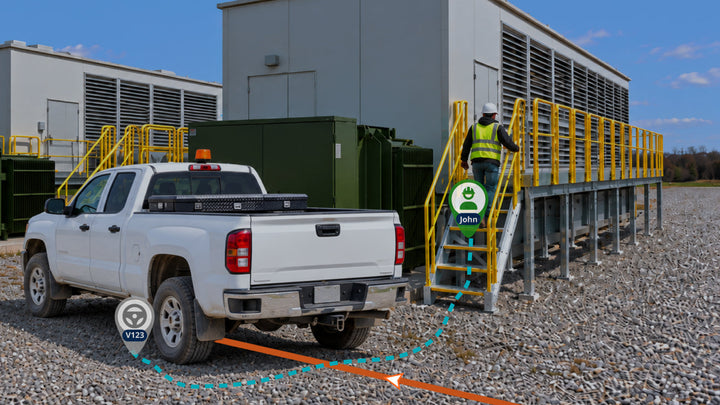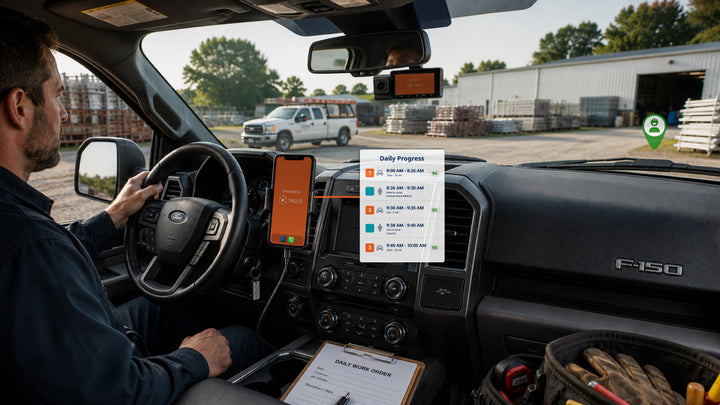


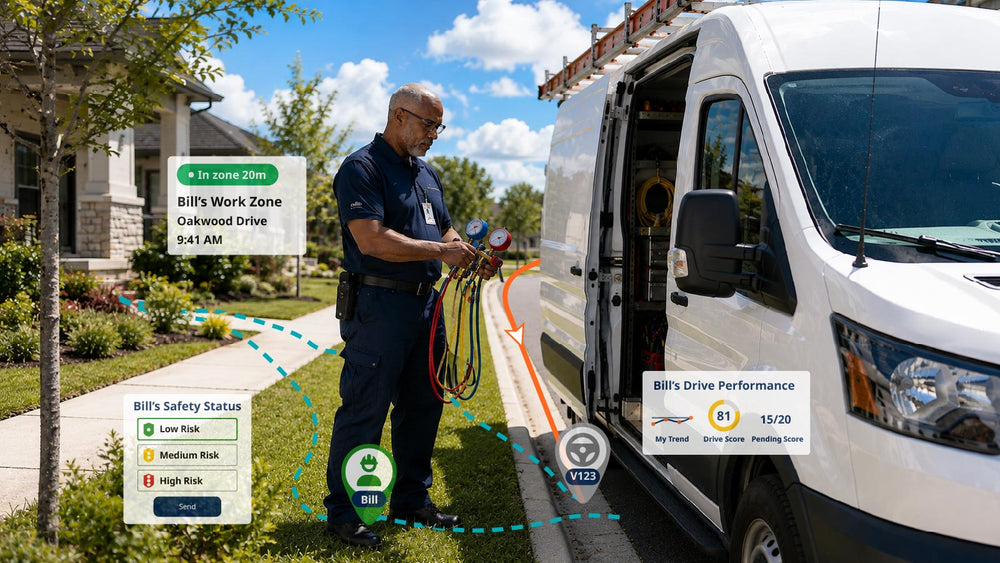
Fleet telematics is the combination of GPS location tracking, onboard vehicle diagnostics and wireless data transmission that lets an operator see where vehicles are, how they are being driven, and how they are performing mechanically. A device in the vehicle collects location, speed, acceleration, braking and engine data, then sends it to a platform where it becomes maps, reports and vehicle driving behavior scorecards. That is genuinely useful, and for asset-heavy operations it is essential. But it is worth being precise about what the category is built to do, because the answer explains why so many field service operators have telematics installed and still feel exposed. Telematics is a vehicle measurement system. It records what a vehicle did. It does a poor job of identifying who was driving. By design, it does not prevent anything, it is a data collection platform, and it stops contributing the moment the engine turns off.
What does fleet telematics actually measure?
Strip away the vendor differences and almost every platform in the category measures the same four things:
- Location and movement. Where the vehicle is, where it has been, how long it stopped, whether it entered or left a defined area. This is the oldest and most reliable part of the category.
- Vehicle based driving events. Harsh braking, rapid acceleration, cornering, speeding against posted or set limits. Derived from an accelerometer and GPS speed.
- Vehicle health. Engine fault codes, battery voltage, fuel or energy consumption, mileage intervals, Odometer, read from the OBD port or the manufacturer's data feed.
- Utilization. Engine hours, idle time, trip counts, how hard an asset is working relative to the rest of the fleet.
Those four categories cover the vehicle completely. If the question you are trying to answer is "where are my vehicles, how hard are they working, and are they about to break down", telematics answers it well.
The trouble starts when the question changes.
What does fleet telematics miss?
Three gaps sit inside the category itself. None of them is a vendor failing. They are consequences of what the system was designed to observe.
It locates and measures the vehicle, not the person behind the wheel
A telematics unit is bolted to an asset. It knows a vehicle braked hard at 2:14 pm. It does not inherently know who was behind the wheel. That distinction matters, because a vehicle creates no performance or safety risk on its own. The risk arrives with the person operating it, along with their habits, their judgment, and their skill.
For a fleet where one named driver sits in one assigned vehicle every single day, that distinction is academic. For field service it is not. Technicians share vehicles, take pool vehicles, swap when one is in the shop, vehicles are moved within the organization. The moment vehicles and people stop mapping one-to-one, every GPS location, every driving score, every threshold event and every coaching conversation needs an administrative step to verify who was actually behind the wheel. Driver to vehicle assignment becomes an administrative imperative.
Vendors have built workarounds - driver ID fobs, login screens, scanners, manual trip reassignment. Each one adds hardware, or adds a task someone has to remember to do, adds a failure point that does not eliminate the administrative validation step. When the attribution is wrong, the wrong person is dispatched, drivers dispute their scores, and any incentive or coaching program built on vehicle scores loses its value, credibility and authority quickly.
It records what happened, it does not prevent it
This is the structural point, and it is the one most worth sitting with.
A telematics platform observes and reports. An alert fires after an event has been detected. A scorecard summarizes vehicle events after a period closes. Coaching happens later still, after ensuring driver identification and in a conversation about something that already occurred in a vehicle.
That is a documentation loop, and documentation has real value: it settles disputes, evidences a safety program, and identifies patterns worth acting on. But every part of it happens after the moment of risk and driver validation. Nothing in a measurement system reaches into the moment itself and changes the outcome.
In safety terms that distinction has a name. The OSHA hierarchy of controls ranks engineering controls, which remove a hazard, above administrative controls, which ask people to behave differently. Telematics plus a policy plus coaching is an administrative control, however well executed. It depends on people choosing correctly, and measures how often they did.
It goes blind when the engine stops
Vehicle-mounted telematics contribute for exactly as long as the vehicle is running.
For long-haul freight that covers most of the working day. For field service it does not. A technician's day is a sequence of drives punctuated by the actual work - on a roof, in a crawlspace, in a customer's home, in a plant room, frequently alone. The vehicle sits in the driveway generating nothing while the part of the day carrying the most operational and duty-of-care risk goes unobserved.
Anything that depends on driver assignment and the vehicle being on cannot see any of it: no jobsite arrival confirmation beyond a geofence ping, no lone-worker check-in, no way to reach someone or for them to escalate.
Why does this gap matter more for field service?
Because field service is not a driving business with some work attached. It is a work business with a lot of driving attached, and the two halves carry different risks.
Three characteristics make the mismatch sharper:
-
Vehicles and people are not permanently paired. Attribution is a live problem, not an edge case.
-
Most of the workday happens outside the vehicle. The tool that stops at ignition-off misses the majority of the exposure.
-
The dominant driving risk is a device, not a maneuver. Harsh braking is a symptom. A phone in a hand is frequently the cause, and it is the one cause that can be engineered out rather than coached against.
That third point is where measurement systems reach their limit most visibly. Telematics can record the hard brake that followed a glance at a screen. It has no mechanism to stop the glance.
Is fleet telematics the same as distracted driving prevention?
No, and conflating them is the most expensive misunderstanding in this category.
They are different classes of system:
|
Telematics |
Distraction prevention |
|
|---|---|---|
|
What it does |
Observes and records |
Intervenes and blocks |
|
When it acts |
After an event |
Before an event |
|
What it produces |
Reports, scores, evidence |
An event that never happened |
|
Control type |
Administrative |
Engineering |
|
Subject |
The vehicle |
The person and the device |
A fleet running vehicle telematics only has a record of distraction-related outcomes. A fleet running telematics plus device-distraction prevention has fewer of those events to record in the first place. Eliminate phone distraction, then use telematics to measure the result: fewer panic braking events, and a drop in the frequency, severity, and cost of rear-end collisions. These are not competing claims about the same job. They are two different jobs, and responsive field service organizations need both.
The practical consequence is that "we already have telematics" is not an answer to the distraction question. It is a statement about measurement capability, and phone use policy and device-distraction is a control problem.
What should a field service fleet actually be buying?
Reframe the purchase around the person rather than the asset, and the requirement list changes:
-
Driver to vehicle attribution that does not need administration. Every trip, every event and every score is tied to the actual driver automatically, without fobs, logins or manual reassignment.
-
A device-use policy control layer, not just a measurement layer. Something that prevents the highest-frequency cause of incidents in the moment, rather than reporting the consequences of iit afterwards.
-
Coverage of the whole workday. Person-first telematics - visibility, communication, incident management - lone-worker jobsite performance and safety that continues after the engine stops.
-
Evidence that survives scrutiny. An auditable chain showing not only what happened, but what the employer did to prevent it - which is the question an insurer or opposing counsel actually asks.
-
The smallest number of systems that produces that record. Every additional platform is another data silo, another contract and another reconciliation job after an incident.
Vehicle-centric telematics satisfies parts of that list well. It cannot satisfy the policy control requirement or the after-ignition jobsite duty-of-care requirement, because neither is what it was built for.
Where TRUCE fits
TRUCE was built for operations where people drive as part of skilled work rather than as the work itself, which is why it starts with the person and their mobile-device as the cornerstone rather than centered solely around the vehicle. TRUCE is employee-centric, driving and working are contextual activities - vehicles are an attribute of a driver associated trip.
TRUCE incorporates automatic device distraction prevention and is an engineering control on the OSHA hierarchy: it removes the hazard in the moment instead of reporting it afterwards, applies policy automatically by context, and cannot be switched off by the user. Because the platform runs on the mobile device the technician carries, every trip and event is attributed to the right person automatically with no fob, login or reassignment step, which is what makes supervisor coaching defensible rather than disputable.
TRUCE AI dashcam context and connected-vehicle diagnostics supply the vehicle layer that telematics traditionally owns, inside the same platform and the same record. The rest of the picture stays continuous rather than stopping at ignition-off. Jobsite visibility, lone-worker check-ins, communication, and field escalation cover the part of the day that happens outside the vehicle.
The point is not that telematics is obsolete. It is that a measurement system and a control system focused solely on the vehicle and not the person is an incomplete workplace tool, answers different questions, and a field service operation needs the answer for both driving and jobsite performance and safety. We looked separately at why running them as separate hardware stacks means paying twice for components you already own.
FAQ
What is fleet telematics? The combination of GPS tracking, onboard vehicle diagnostics and wireless data transmission that lets a fleet monitor vehicle location, vehicle driving behavior and mechanical health. A device in the vehicle collects the data and sends it to a platform that turns it into maps, reports and driver scorecards.
What does fleet telematics measure? Four things: location and movement, driving events such as harsh braking and speeding, vehicle health from engine diagnostics, and utilization such as idle time and engine hours.
Is telematics the same as GPS tracking? No. GPS tracking is one component of telematics. Telematics combines location with vehicle diagnostics, driving-event detection and two-way data transmission, so it reports on how a vehicle is driven and how it is performing, not only where it is.
Is fleet telematics the same as distracted driving prevention? No. Telematics is a measurement system that records events after they occur. Distraction prevention is a control system that stops the behavior in the moment. On the OSHA hierarchy of controls, prevention is an engineering control and telematics-plus-coaching is an administrative control.
Does telematics work when the vehicle is parked? Generally no. Vehicle-mounted telematics contributes while the vehicle is running. For field service, where much of the workday happens on site and outside the vehicle, that leaves the majority of the working day unobserved.
Can telematics tell you who was driving? Not on its own. A telematics unit is fitted to a vehicle, so it records what the vehicle did. Identifying the driver requires an added step such as a driver ID fob, a login, or manual trip assignment, which is a recurring problem in fleets where vehicles are shared.
Ready to look at what your current system cannot see?
Most operators can produce a report of what happened last month. Far fewer can show what stopped an incident happening, or account for the part of the workday that takes place after the engine goes off. Talk to a TRUCE product specialist about what a control layer would add to the measurement layer you already have.
Talk to a TRUCE Product Specialist