

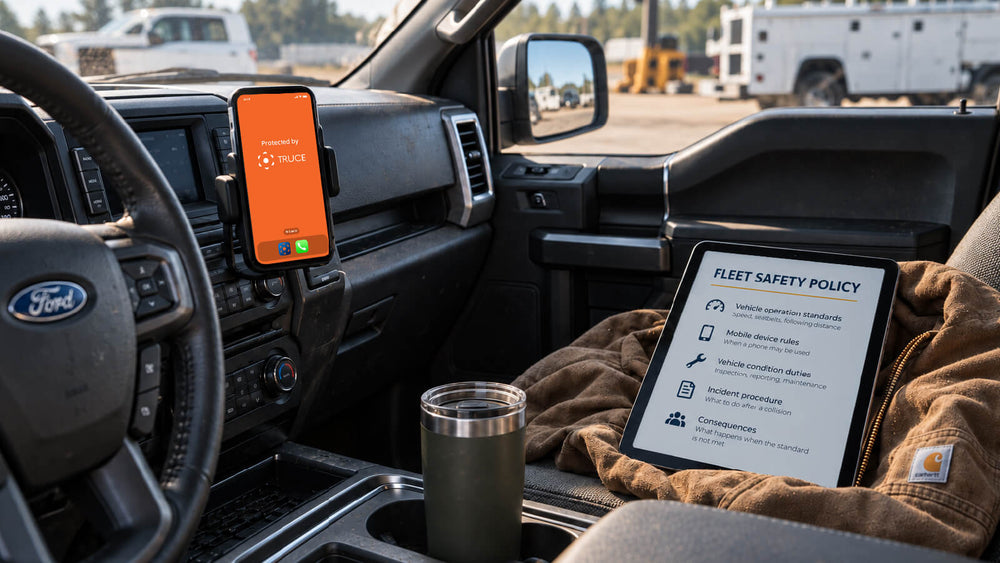
A fleet safety policy is the written standard that sets out how a company expects its people to operate vehicles: personal use, speed, seatbelts, vehicle inspection reporting, maintenance requirements, incident reporting, and almost always a section on mobile device use when the vehicle is in motion. Nearly every field service operator has one, most have employees sign it, and it remains the right foundation for a vehicle use and driving safety program.
But a written policy cannot act. TRUCE platform data shows that a mobile device creates a distraction once every six to ten miles. For an employee driving 20,000 miles a year, that is 2,000 to 3,300 moments of device-distracted driving per employee, and every one of them asks that employee to self-manage against the policy in the moment. In a job built on constant connection and expected responsiveness, that is thousands of individual judgment calls a year, made alone, at speed.
A document that has been written, communicated, and signed does not intervene in a single one. The policy defines the standard and gives the company a defensible position. It does not give the employee any help. Something else has to carry that weight.
What does a fleet safety policy actually cover?
A well-written policy typically sets out:
-
Vehicle operation standards. Speed, seatbelts, following distance, adherence to traffic law, Personal, spouse and significant others use.
-
Mobile device rules. When a phone may be used, whether hands-free is permitted, what is prohibited while the vehicle is in motion.
-
Vehicle condition duties. Pre-trip inspection, reporting defects, maintenance intervals.
-
Incident procedure. What to do after a collision, who to notify, what to document.
-
Consequences. What happens when the standard is not met.
That document does real work. It establishes the expectation, it evidences that the employer set one, it is an acknowledgement that employees understand it, and it is the reference point for any conversation about performance. No safety program should operate without it. Prior to the explosion of mobile devices, written policy was an excellent tool for education and awareness, driver acknowledgement, vehicle performance and safety management, and legal defense.
Policy and administrative protocols were tools before mobile devices became what they are. They still set the standard. What they cannot do is act in the thousands of moments each year, each one lasting seconds, when nothing is there to administer. Those are the moments that decide whether the company and the employee are actually compliant.
Why does a written policy fail to stop device use?
Because a policy asks a person to make a decision, and it asks them to make it at the worst possible moment. That decision is made against an expectation of constant connectivity and responsiveness, on a device specifically engineered to seek attention.
A notification arrives while someone is driving between jobs. Dispatch needs an answer. A customer, a supervisor or coworker is calling and/or texting, an application sends an alert. Responsiveness is the performance and cultural measurement. So, the policy exists, it was signed nine months ago, and none of that is present with the driver at the moment the screen lights up. What is present is a task, a deadline and a device.
Unlike other policy and performance items, the mobile device is not a discipline opportunity, and treating it as one is why communication, awareness, and education programs fail. It is an intentional device and application design problem. The policy is competing against the specific stimulus and response requirement it is trying to prevent - against the backdrop of communication and performance expectations.
Three things make it harder in field service specifically:
-
The phone is the work. Technicians quote, schedule, route, capture signatures and take payment on it. "Do not use your phone" cannot mean what it says, so the rule becomes conditional, and conditional rules require judgment at speed.
-
The pressure is real and it comes from the employer. Dispatch, customers and supervisors generate the interruptions. A policy that asks people to ignore work messages while driving sits in direct tension with the operation's own communication habits.
-
Nothing verifies compliance in the moment. The policy is checked after an incident, if at all. Until then the standard exists only in memory.
How often is the standard actually tested?
More often than most operators assume, which is the number worth internalizing.
TRUCE platform data shows roughly 2,000 device distractions prevented per employee per year while driving. That is not a count of accidents or of policy violations someone reported. It is a count of moments when a device would have taken attention away from the road and TRUCE intervened and provided protection.
At the account level the frequency is starker. At Hulett Environmental, a pest control operator running 169 vehicles, TRUCE prevents more than 250 distractions per employee per month, 3000 per year - roughly one every three miles driven, with zero false positives.
One every three miles. That is the interval at which a written policy is being asked to hold, silently, with no reinforcement, thousands of times a year per person.
Set against the wider risk picture: distraction appears on approximately 36.5 percent of commercial fleet trips, roughly one in three, and texting while driving carries about 23 times the crash-event risk of driving undistracted. The National Highway Traffic Safety Administration recorded 3,275 distracted-driving fatalities in 2023, with handheld device manipulation trending up rather than down over the previous decade.
The policy is not failing because it is badly written. It is failing because it is being asked to do a job no document can do.
What is the difference between a policy and a control?
This distinction is the whole argument, and it comes from occupational safety rather than from marketing.
The OSHA hierarchy of controls ranks the ways a hazard can be managed, from most to least effective:
|
Control type |
What it does |
Example |
|---|---|---|
|
Elimination |
Removes the hazard entirely |
Do not send people to the site |
|
Substitution |
Replaces it with something safer |
Use a less hazardous chemical |
|
Engineering |
Isolates people from the hazard by design |
The device cannot present the distraction while the vehicle is moving |
|
Administrative |
Changes how people are asked to work |
A policy, training, signage, coaching |
|
PPE |
Protects the individual if the hazard reaches them |
Gloves, harness, high-visibility clothing |
A fleet safety policy is an administrative control. So is training. So is coaching after the fact. All three depend on a person choosing correctly under pressure, every time.
An engineering control does not depend on the choice. It removes the opportunity for the hazard to occur, automatically, whether or not anyone remembers the rule.
Every other workplace hazard in a field service operation is already managed this way. Machine guards are not a memo asking people to keep their hands clear. Lockout/tagout is not a reminder. Fall protection is not a policy about being careful on roofs. In each case the industry moved from asking to engineering, because asking does not scale and does not survive a bad day.
Device distraction is one of the few remaining hazards still managed almost entirely by asking.
What does a fleet safety program need beyond the policy?
Reframe the question from "what does our policy say" to "what happens when the standard is tested", and the requirement list changes:
-
A control that acts in the moment, automatically, without depending on the employee remembering the rule or a supervisor watching.
-
Something that still lets the phone do the work. A blunt block fails immediately, because navigation, dispatch and job data all live on that device. The control has to distinguish between the work and the distraction.
-
Attribution to the person, not the vehicle. Scores and coaching that cannot be tied to the right individual get disputed, and a disputed program loses authority quickly.
-
Coaching that follows the event. Prevention handles the moment; improvement handles the pattern.
-
A record of enforcement, not just of policy. Which brings up the question most programs cannot answer.
How do you prove the policy was enforced?
This is where the gap becomes expensive rather than theoretical.
After a serious incident, plaintiff's counsel in commercial vehicle litigation routinely subpoenas the technician's phone records, the carrier's data, the field service software's location history and any camera footage. The question that follows is not whether the employer had a policy. It is what the employer did to make the policy hold.
"We had a written policy and the employee signed it" is a statement about intent. "The device could not present that notification while the vehicle was moving, and here is the record" is a statement about control. Those two answers carry very different weight in an audit, an insurance review or a courtroom, and the second one is only available to an operator who deployed something beyond the document.
Where TRUCE fits
TRUCE was built for operations where people drive as part of skilled work rather than as the work itself, which is why it treats the policy as something to enforce automatically rather than something to remind people about.
Automatic device distraction prevention is an engineering control on the OSHA hierarchy. It applies by context - vehicle movement, location, work status - so the restriction is active while driving for the company. It cannot be switched off by the employee, and it does not require anyone to remember the rule at the moment the screen lights up. Crucially it automates the employer policy, so required any absolute while driving functions like navigation, handsfree stay available.
Because it runs locally on every mobile device, every trip and event is attributed to the right person automatically, which is what makes supervisor coaching defensible rather than disputable. TRUCE AI dashcam context supplies the road-facing record, connected-vehicle diagnostics cover the vehicle, and jobsite visibility and lone-worker check-ins continue after the engine stops. As a full telematics and ai video telematics provider that uniquely eliminates device distraction, TRUCE intercepted 97 million unauthorized app foreground attempts and deferred 35 million incoming notifications in 2025 alone.
The company defined policy is the basis that sets the standard, and no program should run without one. What changes is that the standard stops depending on people and memory, and makes the device automatically policy compliant. We looked separately at the difference between measuring driving and controlling it.
FAQ
What is a fleet safety policy? The written standard setting out how a company expects employees to operate vehicles: speed and seatbelt rules, mobile device use, vehicle inspection duties, incident reporting and the consequences of not meeting the standard.
Why isn't a distracted driving policy enough on its own? Because a policy is an administrative control. It asks a person to make the right decision at the moment they are most pressured, from memory, with no reinforcement present. TRUCE platform data shows roughly 2,000 device distractions per employee per year while driving, and a signed document does not intervene in any of them.
What is the difference between an administrative control and an engineering control? An administrative control changes how people are asked to work: policies, training, coaching. An engineering control removes the opportunity for the hazard to occur by design. On the OSHA hierarchy of controls, engineering controls rank above administrative ones because they do not depend on the individual choosing correctly under pressure.
How often do employees actually get distracted while driving? TRUCE platform data shows approximately 2,000 device distractions per employee per year. At Hulett Environmental, running 169 vehicles, TRUCE prevents more than 250 per employee per month, roughly one every three miles driven.
Can you block phones without stopping people doing their job? Yes, and it is the only workable approach in field service, where the phone runs dispatch, navigation, job data and payment. Context-aware prevention distinguishes work functions from distractions, so the job stays available while the interruption does not arrive.
How do you prove a fleet safety policy was enforced? A signed policy evidences intent. Demonstrating enforcement requires a record that the control was active and operating, which is what an engineering control produces and an administrative one does not.
Ready to make the standard hold on its own?
Most operators can produce their fleet safety policy on request. Far fewer can show what happened the last two thousand times it was tested. Talk to a TRUCE product specialist about what it takes to turn the document into a control.
Talk to a TRUCE Product Specialist
 Schedule a Conversation