


The return on a fleet safety program does not arrive as one headline number. It arrives on four lines of the business: the commercial auto insurance premium, the cost of claims, the risk of a punishing renewal after a single incident, and the litigation exposure that now sits behind every technician on the road. Commercial auto insurance cost is the line most service fleets already budget to rise every year, which is why it is the right place to start the ROI conversation.
This piece lays out what is pushing commercial auto insurance rates up, what a light-duty service fleet actually pays, which safety controls underwriters credit, and how to build the ROI case for a safety program on numbers a CFO and a broker will both accept. Every figure below comes from the 2026 Auto Liability Squeeze field guide and from TRUCE platform data.
Why do commercial auto insurance costs keep rising?
Commercial auto insurance costs keep rising because the line has been unprofitable for carriers for fourteen consecutive years, and the losses are driven by claim severity that keeps climbing faster than rates. Carriers raise prices mechanically to close the gap, which is why even fleets with clean records see increases at every renewal.
The scale of the problem is well documented. AM Best reported commercial auto underwriting losses of roughly $4.9 billion in 2024, with liability alone accounting for $6.4 billion of loss and a combined ratio of 113, essentially unchanged from 113.3 the year before. S&P Global projects the combined ratio will still be above 100 in 2029. The first quarter of 2026 marked the 59th consecutive quarter of commercial auto rate increases.
The structural driver is severity, not frequency. Claim severity has climbed 64 percent since 2015. Thermonuclear verdicts, jury awards above $100 million, rose 81 percent over the same study period. Loss costs are accelerating at roughly 6 percent a year against an average rate increase of 2.9 percent in late 2025, so carriers are losing ground even as they raise prices. The results for buyers:
-
Even clean fleets are seeing 7 to 15 percent rate increases in 2026.
-
United States commercial auto premium increases now range from 10 to 30 percent, depending on carrier and state.
-
Excess and umbrella layers over auto have seen rate increases of more than 75 percent, with some carriers exiting the layer entirely.
What does commercial auto insurance cost a service fleet?
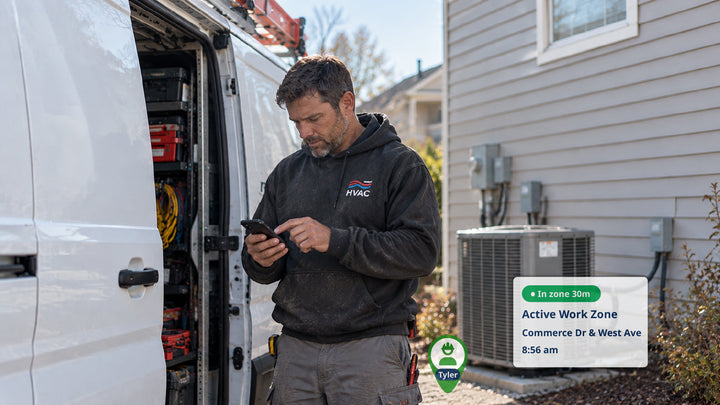
Industry brokers put commercial auto for an HVAC or service technician in the range of $250 to $320 per vehicle per month. A small shop with a handful of trucks can spend $5,000 to $18,000 a year across general liability, workers compensation and auto combined, and auto is consistently the line driving the renewal increase.
Scaled up, the premium line becomes the largest controllable cost most service fleets are not actively managing. As an illustration using the broker range above, a 40-vehicle light-duty fleet is paying somewhere between $120,000 and $154,000 a year for commercial auto before any excess or umbrella coverage. A 7 to 15 percent increase on that line adds $8,000 to $23,000 a year with no change in the fleet's own behavior. That is the baseline any safety investment is measured against.
The exposure behind the premium is what carriers are pricing. Phone interaction shows up on roughly 36.5 percent of commercial fleet trips, texting while driving carries about 23 times the crash-event risk of undistracted driving, and underwriters now treat distracted driving as the primary controllable severity driver in the line.
What ROI can fleet companies expect from safety software?
Fleet companies should expect the return from safety software to show up in four places rather than as a single guaranteed multiple: lower premiums for fleets that can show strong driving scores and prevention controls, fewer and cheaper claims, a renewal that is not derailed by one incident, and a defensible record if an incident does reach litigation. The documented ranges for each are below.
|
Return line |
What moves it |
Documented range |
Source |
|---|---|---|---|
|
Premium |
Telematics scores and provable prevention controls the carrier can see |
15 to 30 percent premium reductions for fleets with strong telematics scores; 15 percent rebates for telematics-enabled coaching |
Field guide, citing broker outlook and Munich Re |
|
Claims |
Fewer incidents and lower cost per incident |
60 percent fewer incidents and 86 percent lower accident costs for fleets using dashcam feedback |
Field guide, citing AXA XL |
|
Renewal risk |
Avoiding the single at-fault distraction claim |
A single claim can move a small service company's premium 30 to 100 percent at renewal, or trigger non-renewal |
Field guide, citing brokers |
|
Litigation exposure |
A record of enforcement rather than a policy on paper |
Median nuclear verdict in commercial vehicle cases roughly $36 million; pre-crash negligence allegations now carry the largest multipliers |
Field guide, citing ATRI |
Against those lines, the cost of a program built for light-duty service fleets is modest. A platform that automatically prevents device distraction and bundles telematics, an AI dashcam and coaching runs about a dollar a day per technician, roughly half the cost profile of legacy vehicle-centric systems, with the dashcam and vehicle connection included in the bundle rather than bought and installed as a separate stack.
Put the two together for the same illustrative 40-vehicle fleet. At $25 per vehicle per month the program costs about $12,000 a year. A premium reduction at the low end of the documented 15 to 30 percent range on a $120,000 to $154,000 auto line is $18,000 to $23,000 a year, before a single claim is avoided. That arithmetic is illustrative, not a promise; actual outcomes depend on loss history, carrier, state and the controls in place. But it shows where the return sits. It sits on the insurance line, and it does not require a heroic assumption to get there.
How much does one at-fault distraction claim cost?
More than the claim itself. Brokers report that a single at-fault, distraction-related claim can move a small service company's auto premium by 30 to 100 percent at the next renewal, and that some operators with adverse loss runs are being non-renewed outright and pushed toward excess and surplus lines, where retentions grow and umbrella capacity shrinks.
The litigation side is what has changed most. Nuclear verdicts, jury awards above $10 million, are now a structural feature of commercial vehicle cases rather than an outlier. The American Transportation Research Institute found the median nuclear verdict reached roughly $36 million, about 50 percent higher than a decade earlier. Social inflation, claim severity rising faster than economic inflation, now accounts for roughly 60 percent of the growth in liability claims. Courts have held employers vicariously liable when an employee causes a crash within the scope of employment, including a $20.9 million verdict against a wholesale distributor whose employee was driving on company business.
The most important shift for the ROI case is where these cases are now won. The crash itself is no longer the center of gravity. Allegations of pre-crash negligence, inadequate policies, ignored safety technology and unenforced rules now carry financial multipliers that exceed most on-road infractions. A written policy the employer took no active step to enforce has repeatedly failed as a defense. The umbrella tower that once absorbed these outcomes is thinner, more expensive and in some cases gone, which makes the primary controls matter more than they did three years ago.
Which safety controls do underwriters actually credit?
Underwriters credit controls they can see in the data and verify in the program: telematics, GPS tracking, dash cameras, maintenance documentation and, weighted most heavily, distracted driving prevention. They now treat these as a baseline requirement for quoting the risk rather than as a discount lever, and some carriers require camera or telematics systems in place just to secure coverage.
The indicators they track are specific. Hard braking compliance. Following distance, with a target of four or more seconds maintained 95 percent or more of drive time. Speeding, with a target of keeping drive time under 5 percent above the posted limit. And distraction prevention, where carriers and defense counsel both recognize the difference between a system that prevents the distraction (engineering control) and a system that alerts and records it afterward (administrative control), Regulators are pushing in the same direction: Louisiana's HB 549, effective for policies issued or renewed from January 1, 2026, is the first state law requiring insurers to offer a liability-premium discount for commercial vehicles equipped with a forward-facing dashcam paired with telematics.
The practical implication is that the same controls that produce the ROI also produce the documentation. A program that can show the carrier a record of enforcement gets credit on the premium line and stands on firmer ground on the litigation line at the same time.
How do you build the ROI case internally?
Build it on the renewal picture rather than on a vendor's multiple. The field guide's twelve-month framework is the practical sequence:
-
Get the renewal picture in writing. Ask the broker for the carrier's current view of the company: flagged exposures, required controls for the next renewal, and the umbrella tower's attachment point and capacity. Most operators do not have this in writing.
-
Map the device entrustment. Count the vehicles on the road and the company-required devices and apps inside them as well as personal devices brought into the workplace vehicle. Confirm whether anything prevents that device use while the vehicle is moving, or whether the company is only recording it afterward.
-
Stress-test the distracted driving policy. Confirm it exists, covers personal devices used for work, and has a documented enforcement mechanism. Underwriters and plaintiff's counsel will ask for all three.
-
Evaluate engineering controls, not just detection. Systems that prevent distraction answer the underwriting question. Systems that report on it afterward support coaching. Both have a role; only the first moves the premium line on its own.
-
Bring the risk stakeholders in. The combination of carrier pressure, nuclear-verdict exposure and the device gap is a governance issue. A short written briefing for the next leadership or safety meeting is the most efficient way to align on the path.
Hulett Environmental, a light-duty service operator running 169 vehicles, is the reference case for how this plays out. The trigger was a new insurance requirement around distracted driving, not an internal mandate. The answer that satisfied it was an engineering control that documents enforcement, now preventing more than 250 distractions per employee per month, about one every three miles.
Where TRUCE fits
TRUCE was built for the loss profile this piece describes:Fleets where the corporate device in the cab is the largest unmanaged exposure. Automatic device distraction prevention is the engineering control underwriters and defense counsel recognize. It acts in the moment, applies on company and personal phones used for work, and produces a record of enforcement rather than a library of violations.
Around it sit the controls carriers expect at baseline. Every trip is attributed to the right technician automatically, so the driving scores a carrier reviews rest on clean data and supervisor coaching is defensible. AI dashcam context supplies the forward-facing record that laws like HB 549 now reward, and connected-vehicle diagnostics cover the maintenance documentation underwriters ask for. The platform runs on the phones technicians already carry, at a cost profile built for service-business budgets. For the policy side of the argument, see why a written fleet safety policy cannot act on its own, and for a worked example in one vertical, what a fleet safety program looks like for an HVAC contractor.
Frequently asked questions
What is the ROI of fleet safety software? The return arrives on four lines rather than as a single multiple: lower commercial auto premiums for fleets with strong telematics scores and provable prevention controls (documented reductions of 15 to 30 percent), fewer and cheaper claims (AXA XL reports 60 percent fewer incidents and 86 percent lower accident costs with dashcam feedback), a renewal not derailed by one incident, and a defensible record if an incident reaches litigation.
How much can telematics reduce commercial auto insurance? Fleets with strong telematics scores see premium reductions of 15 to 30 percent, and Munich Re has documented 15 percent rebates for telematics-enabled employee coaching. The reduction depends on the carrier, the state, the fleet's loss history and whether the program includes distraction prevention, which underwriters now weight most heavily among driving indicators.
Does a dashcam lower commercial auto insurance? It can. AXA XL has reported 60 percent fewer incidents and 86 percent lower accident costs for fleets using dashcam feedback, and Louisiana's HB 549 requires insurers to offer a liability-premium discount for commercial vehicles running a forward-facing dashcam paired with telematics. Carriers increasingly treat cameras as a baseline requirement rather than a discount item.
Why are commercial auto insurance rates going up in 2026? Because the line has posted fourteen consecutive years of underwriting losses, with a combined ratio of 113 in 2024, and claim severity has risen 64 percent since 2015. Carriers raise rates to close the gap, so even clean fleets are seeing 7 to 15 percent increases and excess layers over auto have risen more than 75 percent.
What is a nuclear verdict? A jury award exceeding $10 million. In commercial vehicle cases the median nuclear verdict has reached roughly $36 million, about 50 percent higher than a decade earlier, and awards above $100 million now routinely exceed traditional umbrella coverage. Cases are increasingly built around pre-crash negligence, meaning what the company knew and failed to prevent, rather than the crash alone.
What does a fleet safety platform cost? A platform built for light-duty service fleets that prevents device distraction and bundles telematics, an AI dashcam and coaching runs about a dollar a day per technician, roughly half the cost profile of legacy vehicle-centric systems. The dashcam and vehicle connection are included in the bundle rather than purchased as a separate hardware stack.
Ready to put the numbers in front of your broker?
Most operators can quote their commercial auto premium to the dollar. Fewer can show the carrier the controls that would move it. Talk to a TRUCE product specialist about what the return looks like at your fleet size.
Talk to a TRUCE Product Specialist
 Schedule a Conversation