

A fleet safety program for an HVAC contractor is the combination of policy, technician selection, training, vehicle condition, monitoring, coaching and enforcement that keeps technicians safe between calls and keeps the company insurable. The written policy is one component of it. What separates a program that holds from one that exists on paper is what happens on the road, because for an HVAC fleet the phone runs the job.
Dispatch, work orders, customer texts, navigation, refrigerant records and payment all live on the technician's device, and the technician is driving between jobs all day. Industry brokers now put commercial auto for an HVAC or service technician in the range of $250 to $320 per vehicle per month, and auto is consistently the line driving the renewal increase. This guide covers what a fleet safety program is, why HVAC fleets carry more auto exposure than their size suggests, what the carrier expects to see at renewal, and how to build a road safety program around the device that runs the work.
What is a fleet safety program?
A fleet safety program is the set of standards, controls and records a company uses to manage the risk of employees driving for work. It typically includes a written vehicle and device policy, motor vehicle record checks, onboarding and refresher training, vehicle inspection and maintenance, driving performance monitoring, coaching, incident response and an enforcement mechanism that makes the standard hold.
Most HVAC contractors have several of those pieces already. The gap is rarely the policy, which nearly everyone has, or the maintenance schedule, which the trucks demand anyway. The gap is usually between the standard the policy sets and the mechanism that makes it hold on a Tuesday in July when the board is full, the dispatcher is texting and the technician is fifteen minutes late to the next call. A safety program is only as strong as its answer to that moment.
Why do HVAC fleets carry more auto risk than their size suggests?
Because driving is not incidental to HVAC work. It is the work between the work. A residential service technician can make six to ten stops a day on dense suburban routes with frequent short trips, seasonal peaks that stretch the day, and a customer-responsiveness culture that rewards answering and engaging with applications on the phone. That pattern is exactly the loss profile commercial auto underwriters price against hardest.
The numbers in the 2026 Auto Liability Squeeze field guide put it plainly:
-
Commercial auto has posted fourteen consecutive years of underwriting losses, and even clean fleets are seeing 7 to 15 percent rate increases at renewal in 2026.
-
A small shop with a handful of trucks can spend $5,000 to $18,000 a year across general liability, workers compensation and auto combined, with auto driving the increase.
-
Brokers report that a single at-fault, distraction-related claim can move a small service company's auto premium by 30 to 100 percent at the next renewal, and some operators with adverse loss runs are being non-renewed outright.
-
Phone interaction shows up on roughly 36.5 percent of commercial fleet trips, and texting while driving carries about 23 times the crash-event risk of undistracted driving.
For a fleet of ten trucks that is not an abstraction. It is one claim standing between a manageable renewal and a difficult one.
What does the insurance carrier expect an HVAC fleet safety program to include?
Underwriters now treat safety controls as a baseline requirement for quoting commercial auto rather than as a discount lever. The 2026 broker outlook is consistent: insurers expect telematics, GPS tracking, dash cameras and maintenance documentation as part of a standard risk-control program, and some carriers require camera or telematics systems in place just to secure coverage.
The key performance indicators underwriters now track are specific:
-
Hard braking compliance.
-
Following distance, with a target of four or more seconds maintained 95 percent or more of drive time.
-
Speeding, with a target of keeping drive time under 5 percent above the posted limit.
-
Distracted driving prevention, which is now the severity factor carriers weight most heavily.
The economics line up with the requirements. Fleets with strong telematics scores see premium reductions of 15 to 30 percent. Munich Re has documented 15 percent rebates for telematics-enabled employee coaching. AXA XL has reported 60 percent fewer incidents and 86 percent lower accident costs for fleets using dashcam feedback. And Louisiana's HB 549, effective for policies issued or renewed from January 1, 2026, is the first state law requiring insurers to offer a liability-premium discount for commercial vehicles running a forward-facing dashcam paired with telematics.
The practical reading for an HVAC operator: the carrier will ask what you monitor, and increasingly what you prevent. A program that can show both is in a different conversation at renewal than one that can show a signed policy.
Why should the program be designed around the phone?
Because the phone is the one hazard the company put in the vehicle itself. When an HVAC contractor sends a technician out, it entrusts them with a vehicle and, separately, with a company-required device and the apps on it. The first entrustment is well managed. The second is usually not, and it is the one that now drives the loss profile.
How often it matters is measurable. TRUCE platform data shows a mobile device creates a distraction roughly once every six to ten miles, which works out to around 2,000 device distractions per employee per year while driving. The quality that makes the best technicians great, responsiveness, is the same quality that puts them at risk behind the wheel, and a policy that asks them to ignore work messages while driving sits in direct tension with a dispatch operation built on answering fast.
Hulett Environmental, a light-duty service operator running 169 vehicles, is a useful reference for what the design choice looks like in practice. The trigger was a new insurance requirement around distracted driving. Hulett's first attempt paired AI dashcams with a motion-based mobile app and produced so many false positives, especially on personal phones, that the team spent more time managing the system than benefiting from it. Switching to context-aware enforcement that applies the policy automatically, on company and personal devices, with zero false positives, now prevents more than 250 distractions per employee per month, about one every three miles.
The lesson transfers directly to HVAC. Design the program around the device and the rest of the components have something to stand on.
What belongs in an HVAC fleet safety program?
Every component below belongs in the program. The useful question is what kind of control each one is, because that determines what it can and cannot do in the moment.
|
Component |
Control type |
What it produces |
|---|---|---|
|
Written vehicle and mobile device policy |
Administrative |
The standard, and a signed acknowledgment |
|
Motor vehicle record checks at hire and on a cycle |
Administrative |
Evidence of technician selection |
|
Onboarding and refresher driving training |
Administrative |
Evidence the standard was communicated |
|
Automatic device distraction prevention while driving |
Engineering |
A record of enforcement, not of violations |
|
Driving performance scoring attributed to the technician |
Measurement |
Trend data that can be coached against |
|
AI dashcam |
Detection |
Road-facing evidence and exoneration footage |
|
Coaching delivered to the technician |
Administrative |
Improvement on the pattern, over time |
|
Vehicle inspection and maintenance records |
Vehicle condition |
Documentation carriers expect |
|
Incident response procedure |
Administrative |
A defensible post-event record |
Read down the middle column and the shape of most HVAC programs becomes clear. Nearly everything is administrative or detection. Both are necessary, and both act through the technician or after the event. The single engineering control on the list is the one that acts in the moment without depending on anyone, and it is the one most programs are missing.
How do you coach technicians who are never in the office?
By delivering the coaching to the technician directly rather than routing it through a manager's to-do list. HVAC service managers are already dispatching, quoting, handling escalations and covering calls. Coaching programs that depend on a supervisor pulling a report, scheduling a conversation and following up are the programs that quietly become shelfware.
A program built for a distributed workforce puts the score in the technician's hands. Personal driving scores, delivered in the app after each trip, with peer ranking across the team, create technicians who coach themselves, while supervisors see results rather than tasks. That only works if the score is attributed to the right person automatically. In an HVAC fleet where technicians share vans and cover each other's routes, a vehicle-bolted system that scores the truck rather than the person leaves every coaching conversation open to dispute.
What does it cost, and where does the money come back?
The cost side is straightforward. The TRUCE platform uniquely prevents device distraction and bundles telematics, an AI dashcam and coaching - running about a dollar a day per technician, roughly half the cost profile of legacy vehicle-centric systems, with the dashcam and vehicle connection included rather than bought separately.
The return side has more than one line. The premium line moves with the telematics scores and controls the carrier can see. The claims line moves with fewer incidents and lower accident costs. The renewal-risk line is the 30 to 100 percent swing a single distraction claim can cause, avoided. We lay out the arithmetic in where fleet safety ROI actually comes from.
Where TRUCE fits
TRUCE was built for operations where people drive as part of skilled work rather than as the work itself, which describes every HVAC service fleet. Automatic device distraction prevention is the engineering control in the table above. It applies by context, so it is active while the technician is driving for the company, it keeps navigation and hands-free functions available, and it cannot be switched off by the employee. It works on company-owned phones and on personal phones used for work.
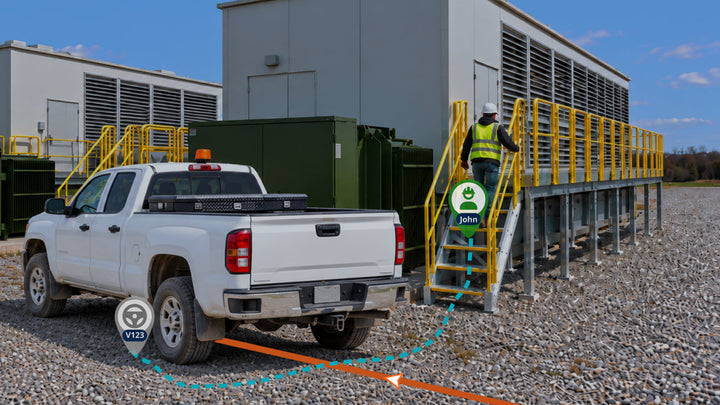
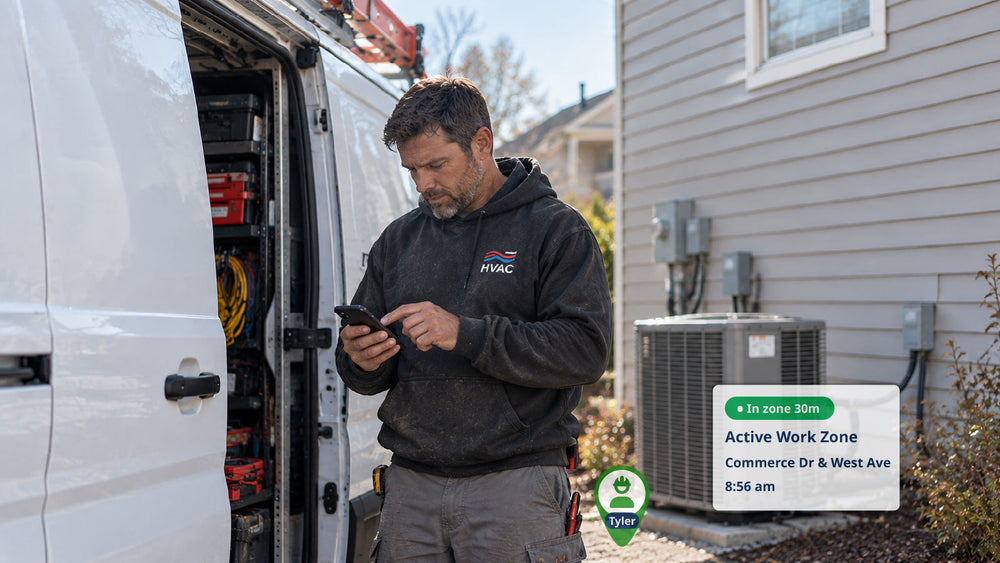
Around that control, every trip is attributed to the right technician automatically, which makes coaching delivered through the app defensible rather than disputable. AI dashcam context supplies the road-facing record carriers expect, connected-vehicle diagnostics cover the vans, and jobsite visibility and lone-worker check-ins continue at the customer's home or on the roof, where a large share of an HVAC technician's day happens. The whole platform, as configured for HVAC and mechanical contractors, runs on the phones technicians already carry. For the framework behind the control-type column, see engineering controls versus administrative controls.
Frequently asked questions
What is a fleet safety program? The set of standards, controls and records a company uses to manage the risk of employees driving for work: a written vehicle and device policy, motor vehicle record checks, training, vehicle inspection and maintenance, driving performance monitoring, coaching, incident response and an enforcement mechanism that makes the standard hold in the moment.
How much does commercial auto insurance cost for an HVAC company? Industry brokers put commercial auto for an HVAC or service technician at roughly $250 to $320 per vehicle per month, and a small shop with a handful of trucks can spend $5,000 to $18,000 a year across general liability, workers compensation and auto combined. Auto is consistently the line driving the renewal increase, with even clean fleets seeing 7 to 15 percent increases in 2026.
What do insurers look for in a fleet safety program? Telematics, GPS tracking, dash cameras and maintenance documentation as a baseline, plus specific driving indicators: hard braking, following distance of four or more seconds held 95 percent of drive time, speeding under 5 percent of drive time, and distracted driving prevention, which carriers now weigh most heavily. Fleets with strong telematics scores see premium reductions of 15 to 30 percent.
Can technicians still use their phones for dispatch and work orders? Yes. Context-aware prevention distinguishes the work from the distraction. Navigation, hands-free calling and the functions the job requires stay available while the vehicle is moving; the notifications and app use that pull attention from the road do not arrive. When the vehicle stops, the device returns to full use for work orders, payment and customer communication.
Does a fleet safety program work for a small HVAC company with ten trucks? Yes, and the exposure argues for it. A single at-fault distraction claim can move a small service company's premium by 30 to 100 percent at renewal. Service fleet customers range from a handful of technicians to several hundred, and a program built on the technician's phone scales down as easily as it scales up.
Do we need to install new hardware in the vans? The program runs on the smartphones technicians already carry, on iOS and Android, on company or personal devices. The platform's AI dashcam and vehicle connection are included in the bundle rather than purchased as a separate system, so there is no second hardware stack to buy, install and maintain alongside it.
Ready to build the program around the phone?
Most HVAC contractors can produce their vehicle policy on request. Fewer can show the carrier what happens in the cab between calls. Talk to a TRUCE product specialist about what a fleet safety program built for HVAC looks like at your size.
Talk to a TRUCE Product Specialist
 Schedule a Conversation