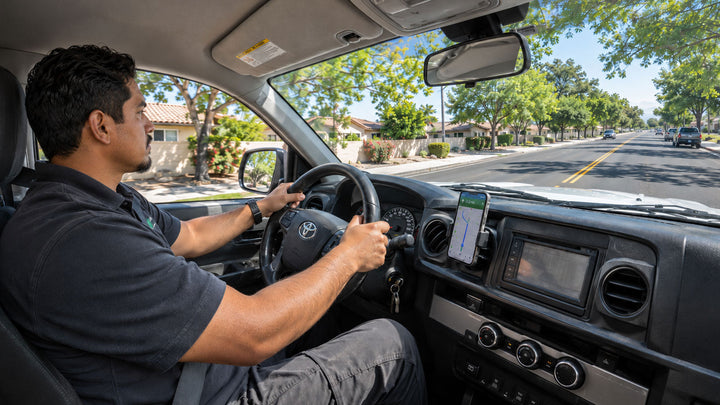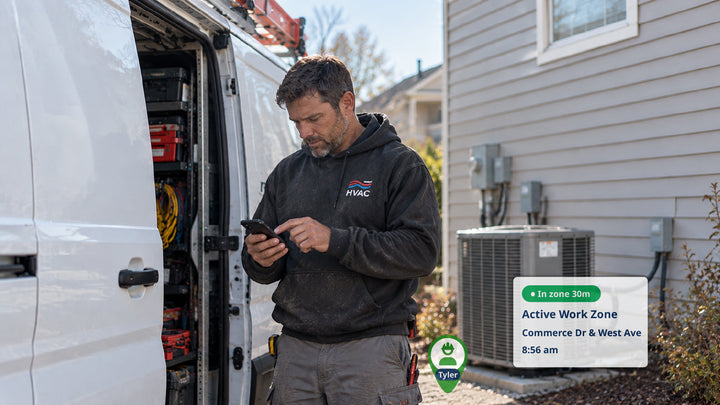


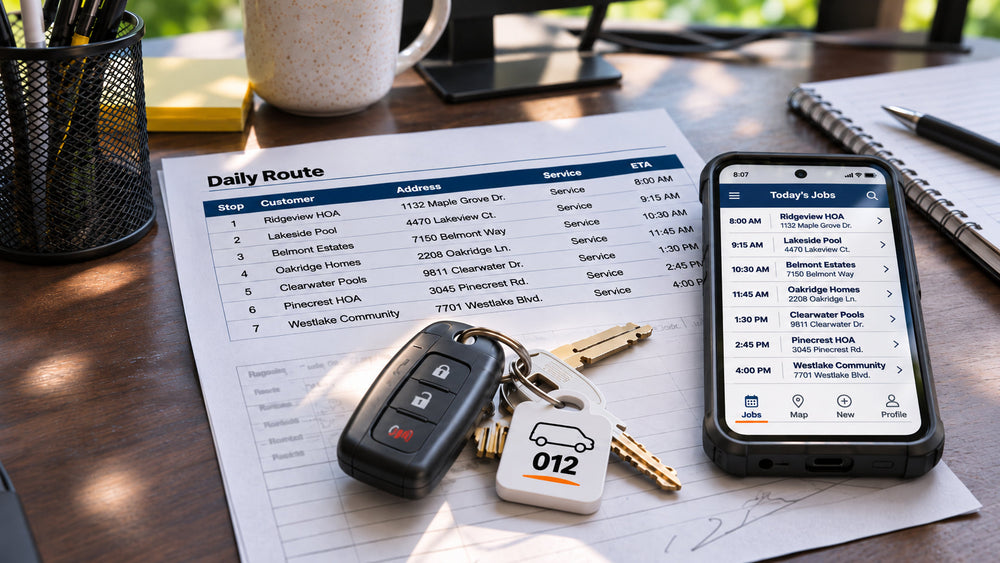
Negligent entrustment is the legal doctrine under which an employer can be held directly liable for handing a dangerous instrument, most often a motor vehicle, to someone it knew or should have known was likely to use it unsafely. It sits alongside respondeat superior, the rule that makes an employer vicariously liable for what an employee does within the scope of employment. A crash on company business pulls the company into the claim on both theories at once, and for a service fleet the exposure has a second layer most operators have never counted: the company-required phone in the cab.
This guide is for the owners, safety directors and risk managers of light-duty service fleets, the pest control, HVAC, plumbing, electrical, landscaping and field service companies whose technicians drive between job sites all day. It explains what negligent entrustment is, how it differs from vicarious liability, why the mobile device is a second act of entrustment, what courts and carriers now expect, and what closes the gap. It is drawn from the 2026 Auto Liability Squeeze field guide and is general information, not legal advice.
What is negligent entrustment?
Negligent entrustment is a direct claim against the party that supplied the instrument, not only against the person who misused it. The classic example is a vehicle: an employer that puts a technician on the road in a company truck has entrusted that employee with something capable of causing serious harm. If the employer knew or should have known the employee was likely to drive it unsafely, and harm follows, the employer can be liable for its own negligence in the entrusting, separately from anything the employee did.
That "knew or should have known" standard is the point. It turns on what the company was aware of and what it did about it: driving records, prior incidents, training, policy and, increasingly, whether the company took any active step to prevent a known risk.
How is negligent entrustment different from vicarious liability?
Vicarious liability, usually argued under the doctrine of respondeat superior, holds an employer responsible for an employee's actions within the scope of employment regardless of whether the employer itself did anything wrong. The employee was working, the employee caused the crash, the employer answers for it.
Negligent entrustment is different in kind. It is about the employer's own conduct: the decision to hand over the vehicle, and what the employer knew when it did. The two theories are pleaded together because they reach different things. Vicarious liability attaches the employer to the employee's fault. Negligent entrustment attaches the employer to its own. In practice, a plaintiff attorney builds the second theory around what the company knew and failed to do, and that is where the case's financial weight now sits.
|
Theory |
What it asks |
What decides it |
|---|---|---|
|
Vicarious liability (respondeat superior) |
Was the employee acting within the scope of employment? |
The employee's conduct and the work relationship |
|
Negligent entrustment |
Did the employer hand over a dangerous instrument to someone it knew or should have known would use it unsafely? |
The employer's knowledge and its own actions or inaction |
|
Direct negligence (policy, training, supervision) |
Did the employer fail to implement or enforce reasonable controls? |
The program on paper versus the program in practice |
Why is the phone in the cab a second entrustment?
When a service company puts a technician on the road, it makes two acts of entrustment, not one. It entrusts the employee with a company vehicle. And it entrusts the same employee with a corporate mobile device and the software that runs on it: the dispatch, navigation, messaging and productivity apps the company requires to operate.
The first entrustment is well understood. Companies vet driving records, set vehicle policies, and increasingly wrap their trucks in telematics and dash cameras. The second entrustment is largely unmanaged, and it is the one that now drives the loss profile.
The device is a second dangerous instrument, and it is one the company chose. Modern phones and apps are engineered to capture attention, built around notifications, streaks and reward loops. Requiring an employee to carry and use that device while driving introduces a foreseeable hazard the company itself created. The company chose the device, requires the device and benefits from the device, and courts increasingly treat the distraction it creates as the company's responsibility to control, not the employee's alone.
How often that hazard fires is measurable. TRUCE platform data shows a mobile device creates a distraction roughly once every six to ten miles, which works out to around 2,000 device distractions per employee per year while driving. For a service company with 120 technicians, that is 120 company-required devices in 120 moving vehicles, every one of them a foreseeable, well-documented distraction the company is responsible for managing.
Does a written phone policy protect the employer?
Not on its own. Courts have repeatedly held that a policy on paper is not a defense when the employer took no active step to prevent the behavior. The most widely cited example is a verdict against Coca-Cola, where evidence showed the company understood the cognitive risk of phone use behind the wheel yet did not engineer it out. Employers have faced verdicts in the tens of millions even where a policy existed and the employee was hands-free at the time.
The reason is the "should have known" standard. A company that writes a distracted driving policy has documented that it knows the hazard exists. If it then does nothing structural to prevent the hazard, the policy becomes evidence of knowledge rather than evidence of care. That is the trap the field guide calls the impossible choice: the company requires the device, knows it distracts, and asks the technician to resist it in the moment while dispatch is calling.
There is a further complication that the camera industry has documented for the plaintiff's bar. Telematics and dash cameras detect and record distraction; they do not prevent it. An inward-facing camera can be worse than nothing in court, timestamping and storing video of the exact behavior the company failed to stop. Detection proves the company could see the problem. It does not prove the company acted on it.
Why has the exposure grown so much?
Three trends are converging to push claim severity into territory carriers cannot price, and every one of them lands on the negligent entrustment theory.
Nuclear verdicts are structural now. Jury awards above $10 million have become frequent enough that awards above $100 million routinely breach traditional umbrella towers. The American Transportation Research Institute found the median nuclear verdict in commercial vehicle cases reached roughly $36 million, about 50 percent higher than a decade earlier, and an earlier study documented a nearly 1,000 percent rise in average verdict size over the prior decade.
Pre-crash negligence is the multiplier. The crash itself is no longer the center of gravity. ATRI research shows that allegations of pre-crash negligence, inadequate policies, untrained drivers and ignored safety technology, now carry financial multipliers that exceed most on-road infractions. Plaintiff attorneys build the case around what the company knew and failed to do. Courts have held employers vicariously liable for crashes within the scope of employment, including a $20.9 million verdict against a wholesale distributor whose employee was driving on company business.
The umbrella above auto liability is shrinking. Excess and umbrella carriers now price auto-heavy risks with the expectation that one severe loss can exhaust a layer. For light-duty service fleets, the umbrella tower that sits over auto liability is getting thinner, more expensive, or disappearing, which makes primary controls matter more, not less.
Commercial auto has posted fourteen consecutive years of underwriting losses. Even clean fleets are seeing 7 to 15 percent rate increases at renewal in 2026, and a single at-fault, distraction-related claim can move a small service company's premium by 30 to 100 percent. For the full picture of what that does at renewal, see where fleet safety ROI actually comes from.
What do carriers and courts now expect an employer to have?
The same thing, from opposite directions: documented controls, not documented intentions.
Underwriters treat safety controls as table stakes for renewal rather than a discount lever. They expect telematics, GPS tracking, dash cameras and maintenance documentation as a baseline, and they weight distracted driving prevention most heavily among the indicators they track. Fleets that demonstrate proactive measures, enforced policies and telematics adoption are better positioned at renewal; fleets with strong telematics scores see premium reductions of 15 to 30 percent.
Defense counsel wants the same evidence for a different reason. In a negligent entrustment claim, the question is what the employer did about a hazard it knew of. A program that can show enforcement, not only a signed acknowledgment, changes the answer. The safety profession's own framework explains why: a policy, a training video and a camera that records the violation afterward are administrative or detection controls, which depend on the employee remembering the rule. An engineering control removes the hazard from the environment and does not depend on memory or discipline. Carriers and plaintiff defense counsel both recognize the difference. We set out the framework in engineering controls versus administrative controls, and the reason the policy document cannot act on its own in why a fleet safety policy cannot stop distracted driving.
What closes the second entrustment gap?
An engineering control on the device itself. Automatic device distraction prevention applies the company's mobile policy by context while the vehicle is moving, on iOS and Android, on company-owned phones and on personal phones used for work. Navigation and hands-free calling stay available if the company allows them; the apps and notifications that pull attention from the road wait until the vehicle is parked. Nothing is asked of the technician and nothing can be switched off by the technician, and the platform produces the documentation that carriers and counsel need to demonstrate enforcement: a record of what was prevented, not a record of violations.
Around that control, AI dashcam context supplies the road-facing evidence carriers expect and settles false claims quickly, every trip is attributed to the right technician automatically so the record is defensible, and coaching delivered to the technician's phone turns the remaining events into documented improvement. Two pest control fleets that made exactly this move, one ahead of an incident and one at a carrier's request, are in the Romex and Hulett story.
The field guide's practical sequence for the next twelve months applies directly: get the carrier's view of the company in writing, count the vehicles and the company-required devices inside them, stress-test the distracted driving policy for an enforcement mechanism, evaluate engineering controls rather than only detection controls, and bring the owner and risk stakeholders into the conversation. The device count is the step most operators have never done.
Frequently asked questions
What is negligent entrustment? A legal doctrine under which the party that supplied a dangerous instrument, typically an employer providing a vehicle, can be held directly liable for entrusting it to someone it knew or should have known was likely to use it unsafely. It is a claim about the employer's own conduct and knowledge, separate from the employee's fault.
What is the difference between negligent entrustment and vicarious liability? Vicarious liability (respondeat superior) makes an employer answer for an employee's actions within the scope of employment, regardless of the employer's own conduct. Negligent entrustment is about the employer's own decision to hand over the instrument and what it knew at the time. Both are usually pleaded together after a crash on company business.
Can an employer be liable for an employee's car accident? Yes, on more than one theory. If the employee was acting within the scope of employment, the employer can be vicariously liable. If the employer knew or should have known of a risk and failed to act on it, negligent entrustment and direct negligence claims can follow. Courts have returned verdicts in the tens of millions on these theories, including a $20.9 million verdict against a distributor whose employee was driving on company business.
Is a company phone a form of entrustment? The field guide's argument is that it is: the company chose the device, requires it and benefits from it, and courts increasingly treat the distraction it creates as the company's responsibility to control. A company-required phone in a moving vehicle is a foreseeable hazard the employer introduced, which is the core of a "should have known" analysis.
Does a distracted driving policy protect a company from negligent entrustment claims? Not by itself. Courts have held that a policy on paper is not a defense when the employer took no active step to prevent the behavior, including in cases where the employee was hands-free. A written policy documents that the company knew of the hazard. What protects the company is evidence of enforcement.
Can technicians still use their phones for dispatch and navigation? Yes. Context-aware prevention distinguishes the work from the distraction. Navigation, hands-free calling and the functions the job requires stay available while the vehicle is moving; the notifications and app use that pull attention from the road do not arrive. When the vehicle stops, the device returns to full use.
Ready to count the second entrustment?
Most service fleets can list their vehicles. Fewer have counted the company-required devices inside them, or can show what prevents those devices from distracting the person driving. Talk to a TRUCE product specialist about what documented enforcement looks like for a fleet your size. This article is general information drawn from the 2026 Auto Liability Squeeze field guide and its cited sources. It is not legal advice. Consult counsel about your company's specific exposure.
Talk to a TRUCE Product Specialist
 Schedule a Conversation