

Fleet fuel cost control starts with the one variable you can actually move: how each vehicle is driven. Fuel sits in the top three line items on most field and commercial P&Ls, behind only labor and the vehicles themselves, and driver behavior - speeding, rapid acceleration, hard braking, and idling - influences as much as a third of total fuel consumption. Disciplined behavior programs typically cut fuel spend 6 to 12 percent. On a $6,000-per-vehicle annual fuel bill, that is roughly $360 to $720 per vehicle every year, recurring, with no new vehicles, no new fuel contracts, and no change to the routes or the work itself.
Why is driver behavior the biggest controllable fuel cost?
Leaders spend enormous energy on the parts of the fuel number they cannot move: the price at the pump, the duty cycle the work demands, the routes customers dictate. The part they can move, consistently and at low cost, is how the vehicle is driven. The same truck, on the same route, with the same fuel, returns materially different miles per gallon depending on the person behind the wheel.
The physics are well documented. The U.S. Department of Energy finds that aggressive driving lowers gas mileage by roughly 15 to 30 percent at highway speeds and 10 to 40 percent in stop-and-go traffic. Oak Ridge National Laboratory reached the same conclusion: sensible driving saves far more fuel than most people assume. Four behaviors do most of the damage, and each one is visible in telematics data:
-
Speeding. Fuel economy falls off rapidly above about 50 mph. Every 5 mph over that threshold is comparable to paying an additional 27 to 32 cents per gallon at today's prices. A habitual 8 to 10 mph overage is a permanent tax on every gallon purchased.
-
Rapid acceleration. Jackrabbit starts burn fuel that smooth acceleration never spends, and it is one of the easiest habits to correct once someone can see it.
-
Hard braking and harsh cornering. Late, heavy braking throws away momentum that was bought with fuel, then demands more fuel to rebuild speed. The cost shows up twice: in fuel and in brake and tire wear.
-
Idling. An idling engine returns zero miles per gallon while still burning fuel, from about 0.16 gallons an hour for a small engine up to roughly half a gallon an hour with the air conditioner running. The Department of Energy estimates idling costs up to about three cents every minute, and nationally an estimated 6 billion gallons of fuel are wasted to idling every year.
None of these fixes require new vehicles, fuel contracts, or routes. They require that the people doing the driving understand what they are doing and have a reason to change.
How much can better driving actually save?
The case is best made per vehicle, so any operation can multiply by its own count. Take one gasoline work vehicle covering 25,000 miles a year at 15 miles per gallon, with fuel at $3.60 per gallon. That single vehicle burns roughly 1,670 gallons and about $6,000 of fuel a year. If driver behavior influences up to a third of that consumption, behavior accounts for close to $2,000 of the annual fuel cost on that one vehicle.
You will not capture all of it. But the published range for what disciplined behavior programs actually deliver, a 6 to 12 percent reduction in fuel spend, is both credible and conservative against the underlying physics. On a $6,000 per-vehicle fuel cost, that works out to:
-
A modest, early-stage program (about 6 percent): roughly $360 per vehicle per year.
-
An established, sustained program (about 9 percent): roughly $540 per vehicle per year.
-
A mature program with active engagement (about 12 percent): roughly $720 per vehicle per year.
Multiply by the operation to scale it: 100 vehicles is $36,000 to $72,000 a year, and 500 vehicles is $180,000 to $360,000. These figures are illustrative and depend on duty cycle, baseline behavior, and program adoption, but the lever is real: it is large, controllable, and effectively free to pull, with no capital outlay.
Why do most fuel-behavior programs plateau?
If the savings are this clear, why do so many fleets fail to capture them? Most have already bought telematics and layered on scorecards, points, and leaderboards. The problem is rarely the idea. It is the plumbing underneath it, and three failure modes show up again and again:
-
The data describes vehicles, not people. When a score is tied to a truck rather than the person who drove it, accountability blurs the moment two employees share a vehicle, someone takes a pool vehicle, or an assigned vehicle is in the shop. People dispute results they do not trust, and supervisors lose the thread.
-
People get limited or untimely access to their own performance. In most legacy approaches, someone sees their score only after a reporting period closes, in a weekly meeting or a periodic review. By then the trips are old and the moment to correct a habit has passed. The person whose foot is on the pedal is the last to know how they are doing.
-
Coaching matters to management but rarely happens in the field. Supervisors are measured on output, not on running coaching sessions. Delivering delayed, punitive-feeling feedback is the easiest task to defer, so the program stays a priority on paper while going unexecuted in the field.
The research is blunt: in-vehicle feedback improves the average person's fuel economy by only about 3 percent, but those who actively engage with their own feedback improve by roughly 10 percent. The difference is not the technology. It is whether the individual has personal, timely visibility, the ability to measure against peers, and the ability to make corrections before the period ends.
How does TRUCE change the equation?
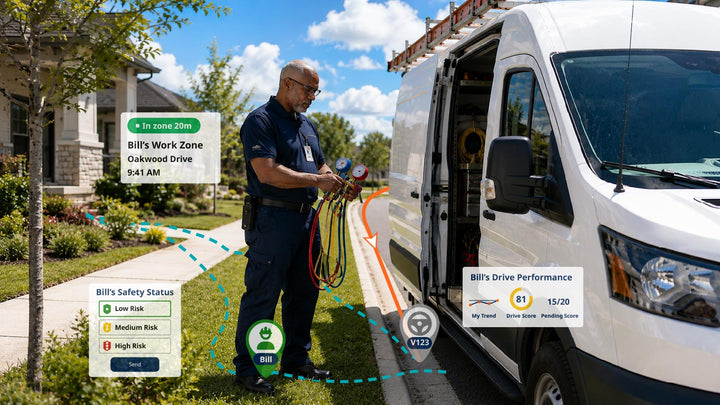
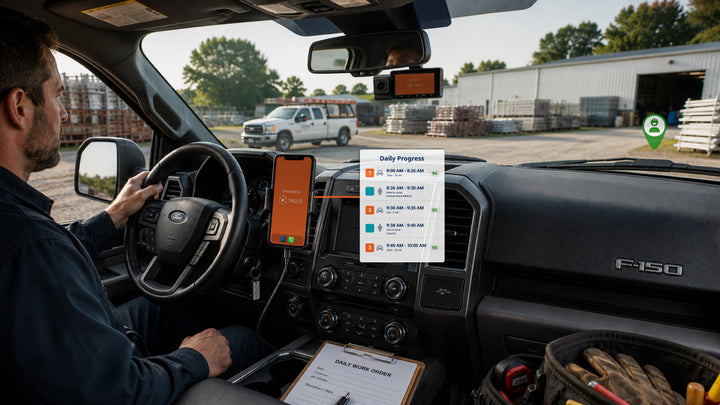
This is the principle TRUCE built Empower around. The starting point is not the manager's dashboard. It is the individual employee, in the moment. Empower gives every person who drives for work direct, in-app access to their own performance: a personal Drive Score broken down by the exact skills that move fuel and safety, speeding, acceleration, braking, harsh events, and device distraction, with trends they can watch improve during the reporting period.
Because every trip is automatically attributed to the actual person rather than to a vehicle, the score is one they recognize and trust, no matter which truck they took that day. And because the feedback arrives close to the trip rather than weeks later, it lands while it can still change what happens next. On top of that, a Green Streak rewards consecutive days of compliant driving, and individual, team, and companywide leaderboards let people see where they stand. The competition is organic rather than imposed: people improve because they can see their own progress and want to climb.
How does coaching make the change stick?
Personal visibility starts the change. Coaching makes it last. On its own, a self-service model tends to miss the people who need it most, and no supervisor focused on productivity can personally ensure both positive and corrective coaching for every employee. This is the work TRUCE Engage automates:
-
Direct coaching. Supervisors deliver real-time corrective feedback or supportive recognition straight to the employee's app, and both sides connect directly.
-
Guided coaching. Positive and corrective coaching threads start automatically when a behavior crosses a threshold the organization defines, with the relevant context and, where cameras are present, video. It handles correction and reinforcement without a busy manager needing to initiate.
The strategic value for leadership is consistency at scale. Every employee receives timely, fact-based feedback tied to their own attributed performance, and every interaction is logged. Together the two modules close the loop: Empower gives the individual the visibility to improve, and Engage ensures the coaching that sustains it reaches everyone, at scale.
Fuel and safety: one effort, two of your largest costs
The behaviors that waste fuel are, almost without exception, the same behaviors that create risk and contribute to crashes. Speeding, hard acceleration, late braking, and distraction sit at the top of both lists. That overlap is the most attractive feature of a personalized behavior program: a single effort pays down two of the largest costs on the books at once. When driving smooths out, fuel spend falls, brake and tire wear decline, and crash frequency drops. For a finance team, the crash side of that ledger often dwarfs the fuel side once the full cost of an incident is counted, so a program justified on fuel alone tends to deliver its largest return through risk and claims.
Beyond behavior: the complete picture of fuel spend
Everything above is something TRUCE delivers on its own, with no fuel card and no integration required. But seen across the whole budget, fuel leaves in three ways, and a complete program addresses all three:
-
Reduce demand. No control at the pump can recover a gallon that never needed to be burned. Empower and Engage lower the fuel a fleet consumes before a single card is ever swiped. This is the foundation, and for many fleets it is enough on its own.
-
Control the purchase. Fuel-card leakage, personal fill-ups, premium grades, off-hours purchases, and outright fraud is widely estimated to consume 5 to 12 percent of fuel spend. A fuel card turns the company card into a policy engine: spending limits, product and merchant controls, gallon and tank-capacity rules, time-of-day rules, and driver authentication.
-
Verify the transaction. The quietest leak is the purchase never matched to a vehicle and a tank. TRUCE Maintain supplies the connected-vehicle and attributed-driver data that lets a fuel-card platform confirm the vehicle was actually at the station and that the gallons fit the tank. A card swiped fifty miles from the truck, or a 40-gallon purchase into a 25-gallon tank, does not clear.
Through the TRUCE Alliance Partner Program and published REST APIs, the fuel-card layer and TRUCE data connect into one system. TRUCE owns the first layer outright; the second and third are optional extensions a fleet can add when it chooses.
FAQ
How much can a fleet save by improving driver behavior? Disciplined behavior programs typically cut fuel spend 6 to 12 percent. On a $6,000 per-vehicle annual fuel bill, that is roughly $360 to $720 per vehicle per year, or $36,000 to $72,000 a year across 100 vehicles, with no capital outlay.
Which driving behaviors waste the most fuel? Speeding (every 5 mph over 50 mph is like paying 27 to 32 cents more per gallon), rapid acceleration, hard braking and harsh cornering, and idling (up to about three cents per minute, roughly 6 billion gallons wasted nationally each year).
Does TRUCE replace my telematics or fuel card? No. TRUCE reduces the gallons burned through behavior change, and runs alongside the tools you already have. Where a fuel card is present, TRUCE Maintain data integrates with it through the Alliance Partner Program to control and verify purchases.
Do I need a fuel card to benefit? No. The behavior layer, the largest controllable variable in the fuel budget, requires no fuel card and no integration to start working. A fleet can adopt TRUCE, cut the gallons it burns, and improve safety as a complete program in its own right.
Ready to move the largest controllable variable in your fuel budget?
Fuel is one of the few operating costs that is large, controllable, and effectively free to pull. Talk to a TRUCE product specialist about the platform, and about the Alliance Partner integrations that complete the picture: fewer gallons burned, every purchase inside policy, and every transaction verified against the vehicle and the person who drove it.
Talk to an Expert